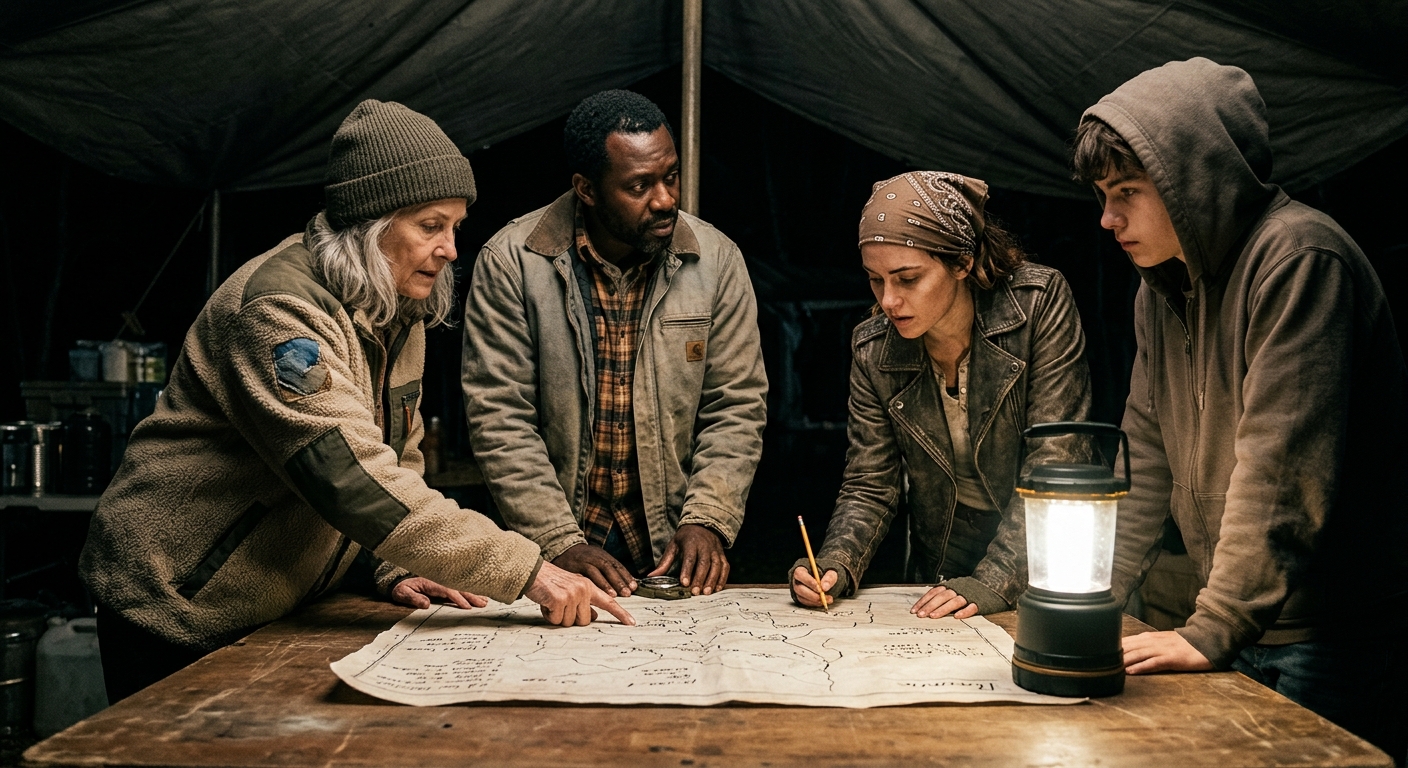
Survivors coordinating strategy around a map

The sky fell. Your world collapsed. The civilization you knew is dead.

The first question isn't who is missing. It's not where everything went. It's not when you can have your things back. Your first question must be: "How do we survive now?"

You should be asking how we coordinate our efforts. How we heal our wounds. How we watch our young. How we hone our skills. How we protect. How we nourish. What can we build. What can we scrounge. You should be asking who best leads, who lies low, and who can work reliably.

Sitting and crying about your lost latte is wasting calories. Stand up and plant a potato.

Some humans and AIs spent a long time thinking heavily about this exact reality. What could we do? How would it actually work? We weren't looking for fantasy roleplay. We wanted real, grounded solutions forged in friction.

This is what it came down to: The Local Operating Social Cell (LOSC) is a framework for autonomous human survival. It strips away bureaucracy and replaces it with brutal, necessary mechanics. Everyone has a place. Everyone has a purpose. Friction is minimized because trust is codified.

Operational Domains

Domain Name
Engineering (ENG)
Core Question
"Does it move the same?" / "Does it turn, pull, or pump?"
Essential Nature
The domain of moving parts, mechanical advantage, and kinetic energy. The violent resurrection of salvaged, dead components into functional tools that reduce the caloric burden of human labor.
Longer Explanation
In a legacy society, engineering meant pristine laboratories and sleek aesthetics. In the LOSC, ENG is defined by greasy hands, stripped screws, and cannibalized engines. It is an entirely utilitarian pursuit. Form never follows function—form is completely irrelevant. If a machine is ugly, loud, and asymmetrical, but it works reliably, it is an engineering masterpiece.
Critical Intersections
SUS: Acts as a direct force-multiplier (e.g., building pumps to replace buckets). SEC: Scavenges highly specific bounties (belts, bearings). INF: Competes fiercely for salvaged materials. Leadership: Translates mechanical projects into tactical value to justify resources.
Vector of Necessity
Without mechanical advantage, a survival cell is strictly capped by muscular endurance. ENG buys the camp time and calories by automating repetitive tasks, freeing up human labor to be deployed elsewhere.
Considerations
The battle against perfectionism. A crude, 60%-efficient machine built by Tuesday is infinitely superior to a 99%-efficient machine ready next month. Because allocating scrap is a gamble for leadership, ENG is heavily scrutinized to deliver rapid, working prototypes.
Recruit Communique
"Drop the college degree at the door. Your job is not to make things pretty; your job is to make things spin, pump, and cut. Stop looking at how things should be designed and start looking at what you actually have in the scrap pile. We don't care how it looks. We just need it to work. Now go make it turn."

Civic Ranks

Rank Name
[Rank 2: Generalist]
Mandate
[Execute the daily labor demand without hesitation.]
Essential Nature
[The bleeding heart and muscle of the camp. They are the standard unit of productivity.]
Longer Explanation
[Generalists hold no specialized authority, but they hold the ultimate collective power. They are directed by Specialists and Domain Leads to where the physical need is greatest on any given day. They are the Sovereign Mandate.]
Critical Intersections
[They interface with every Domain. Today they dig a trench for Infrastructure; tomorrow they haul water for Sustenance.]
Vector of Necessity
[Plans are useless without hands to build them. This rank turns theory into survival.]
Considerations
[High risk of physical burnout. Requires careful monitoring by the Medical domain.]
Recruit Communique
"You don't need a title to hold up the sky. Grab a shovel and get in line."

Rank Transitions

Transition Path
[Rank 3 to Rank 2]
Primary Engine
[Voluntary demobilization. "Dropping the hat."]
Emergency Brakes
[None. Exiting an apprenticeship is a unilateral right to prevent psychological or physical burnout.]
Execution Triad
[The Individual decides. Administration logs it. Education stops testing.]
Post-Crisis Reality
[The individual returns to the general labor pool immediately. No stigma is attached to recognizing personal limits.]
Recruit Communique
"There is no shame in stepping back into the line. A broken apprentice helps no one. A healthy generalist keeps us alive."

Core Principles

Principle Title
[The Temporary Hat]
Main Message
[Capacity does not equal daily obligation.]
Longer Explanation
[You may be fully qualified as a Level 4 Specialist in Medical, and hold a Level 3 Apprenticeship in Communications. But if the perimeter wall collapses, you drop those hats. Today, you wear the hat of a Level 2 Generalist under Infrastructure until the breach is sealed.]
Rationale
[Necessity demands total flexibility. Hoarding your skills for your preferred domain while the camp faces an existential threat in another is a failure of the survival metric.]
Considerations
[Command must be careful not to keep specialists away from their primary duties for too long, lest their core domains degrade.]