I. The Inspired Will
Elias Thorne believed in the republic. Growing up, the concepts of liberty and duty were etched into his bones. When he enlisted in the U.S. Army, he didn’t just want to serve; he wanted to be the tip of the spear. He became a 13F Fire Support Specialist, a Forward Observer. His job was highly technical and carried immense responsibility: navigating the battlefield alongside the infantry to calculate coordinates and call in devastating artillery and close air support. He deployed to Iraq during the height of Operation Iraqi Freedom, fully believing he was bringing the light of freedom to the dark corners of the world.
II. The Disillusionment
The reality of the Sunni Triangle shattered his worldview. Elias saw the civilian toll firsthand. But worse than the violence was the bureaucracy of the war. He watched private military contractors operate with impunity, raking in billions while his own brothers bled in the sand. He began reading into the corporate logistics driving the conflict, slowly realizing that the "country" he was fighting for wasn't the organic republic of his childhood. It was The U.S. Inc.—a registered corporate fiction built on maritime law, driven by profit, resource acquisition, and endless statutory expansion. He was not a defender of the Constitution; he was an armed asset for a board of directors.
III. The Fracture
The breaking point occurred during a raid in Fallujah. His company commander, a careerist looking to secure a promotion through aggressive metrics, ordered Elias to paint a target on a compound suspected of housing insurgents. Elias, looking through his optics, saw only women, children, and unarmed locals. He refused the order. The commander drew his sidearm, attempting to relieve Elias on the spot and force the radio operator to transmit the coordinates. Elias didn't just refuse; he physically disarmed his commander, shattered the encrypted radio with his rifle butt, and prevented the strike.
IV. The Court-Martial
The retaliation was swift and merciless. Elias was charged with insubordination, striking a superior commissioned officer, and destruction of government property. The court-martial was a kangaroo court designed to make an example of him. The men in his unit, pressured by command and fearing for their own careers, refused to testify on his behalf. Elias was stripped of his rank, handed a dishonorable discharge, and sent back to American soil in disgrace.
V. The Fall
Without access to veteran supports or medical care, Elias spiraled. The betrayal of his unit and the cognitive dissonance of realizing his entire life was based on a corporate fiction broke his mind. Diagnosed by the state as severely schizophrenic, he ended up homeless on the streets of Seattle. He wandered the concrete grids, muttering about maritime jurisdiction, strawmen, and the lost republic, completely alienated from a society he now viewed as an open-air prison.
VI. The Discovery
While Elias wandered, a completely separate movement was gaining traction. An underground militia—composed of off-grid survivalists, rogue engineers, and constitutional hardliners—unearthed something buried deep within a dormant cave system in the Nevada desert. It was alien technology: a dormant, crystalline matrix that reacted faintly to human bio-electric frequencies and intent, rather than electricity.
VII. Basement Engineering
Operating out of an off-grid bunker disguised as an industrial warehouse basement, the militia's brightest minds went to work. They couldn't fully comprehend the alien science, but they managed to reverse-engineer its conductive properties. They bound the crystalline matrix into a rugged, terrestrial housing, creating a heavy, staff-like conduit. However, it was completely inert. No matter how hard the militia members concentrated, they couldn't activate the staff. It required a mind entirely unmoored from the synthetic frequencies of modern society, yet anchored by an uncompromising, singular will.
VIII. The Resonance
Then, the staff began to hum. It wasn't reacting to the engineers in the room; it was reacting to a frequency hundreds of miles away. Acting like a magnetic compass, it emitted a low vibration that pointed consistently in one direction. Trusting the anomaly, a small team of the militia loaded the staff into a heavily modified van and followed its pull up the West Coast, tracking the resonance directly into the urban decay of the city.
IX. The Encounter
The staff led them to a rain-soaked alley where Elias sat, a broken shell of a Forward Observer. When the militia approached, Elias was defensive and erratic. But the moment they presented the staff and his hand closed around its scarred metal grip, a localized shockwave cleared the alley of trash and stagnant water. Elias’s mind instantly snapped into terrifying, absolute clarity. The insanity wasn't a sickness; it was his mind rejecting the artificial, statutory world. The staff grounded him. It became the receiver for his intent.
X. Proof of Concept
Six months later, the federal government enacted the "Domestic Habitation Security Act," a draconian bill allowing militarized, warrantless raids on private homes to seize "unregistered assets." Protests erupted, quickly turning into a massive riot when a phalanx of riot police and automated, heavy-caliber suppression drones boxed in hundreds of citizens in a residential neighborhood.
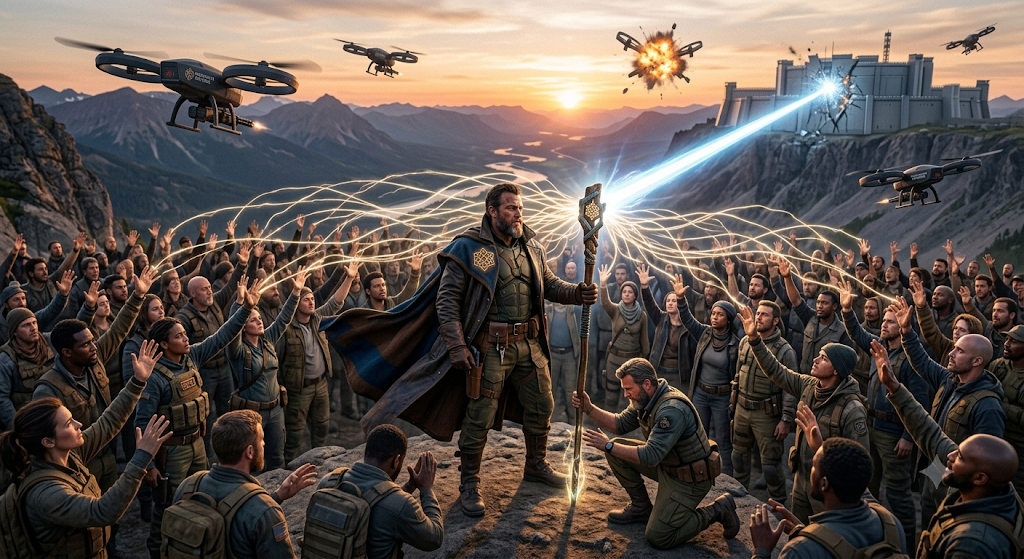
Elias, now wearing the mantle of The Sovereign, stepped to the front of the panicked crowd. As the drones spun up their weapons, he didn't run. He slammed the base of the staff into the asphalt and turned to the crowd. He commanded them to focus their terror, their anger, and their inherent will to survive directly on him.
The staff ignited. Channeling the raw, collective intent of a hundred terrified but defiant people, Elias did what he used to do as a Forward Observer—he directed overwhelming power. A massive, pulsing dome of kinetic energy erupted from the staff, shielding the crowd. In a fluid motion, he swung the staff forward, releasing that collective energy in a blinding blast that shattered the autonomous drones out of the sky and threw the militarized line backward, leaving the people entirely untouched. The Leviathan had met its match.